Why I Re-ran This Comparison for 2026
I went back through Semrush and Ahrefs this year with a simple goal: figure out which one I’d actually pay for if I were starting fresh in 2026. Not which one has the louder marketing. Not which one wins on one flashy feature. I wanted the builder answer. Which tool helps me find opportunities faster, make decisions with less guesswork, and ship SEO work without getting buried in tabs.
I’ve used both on real projects, from small content sites to client work to rough little experiments that probably should have stayed in draft. Some parts felt familiar. Some changed more than I expected. A few things that used to be clear advantages are now a lot closer. And one of the biggest takeaways is that “better” depends a lot on how you actually work day to day.
So this is the practical version. What changed, where each tool still pulls ahead, where each one annoyed me, and how I’d choose now if money and time both mattered.
What Changed Since the Last Round of Comparisons
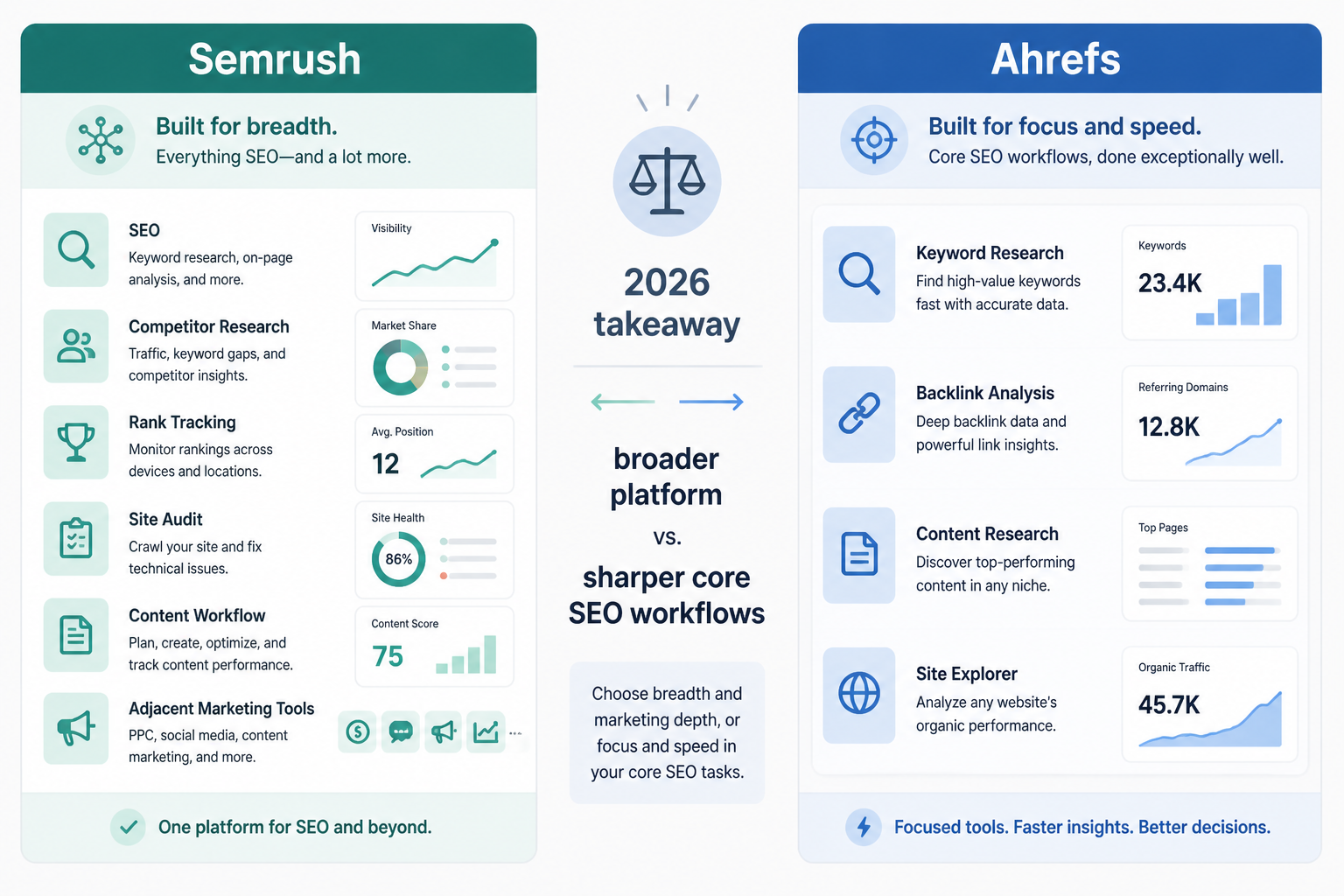
The old Semrush vs Ahrefs debate used to be easier to frame. Semrush was the giant Swiss-army-knife platform. Ahrefs was the cleaner, tighter SEO research tool with a lot of love from content and link builders. That framing still kind of works, but it feels less complete in 2026.
Semrush kept pushing wider. It still feels like the platform built for teams that want one place for SEO, competitor research, rank tracking, site auditing, content workflows, and a bunch of adjacent marketing tasks. If you live inside reports and want to connect a lot of moving parts, Semrush keeps making that easier.
Ahrefs, on the other hand, still feels sharper in some core SEO workflows. Keyword research is fast. Competitive digging is straightforward. Backlink exploration is still one of the first things I trust there. The interface generally gets me to the “okay, here’s the actual opportunity” moment faster.
The big change is that both tools have spent more time smoothing rough edges. Semrush has become easier to navigate once you know what matters. Ahrefs has broadened enough that it no longer feels like a narrower specialist tool in the way people used to describe it. The gap between “platform” and “pure SEO tool” is still there, but it’s not as dramatic.
My Testing Setup
I compared them the way I actually use them, not through a giant spreadsheet of every feature on the pricing page. I ran the same kinds of jobs in both:
- Finding low-competition keyword ideas for new content
- Checking which pages drive traffic for competitors
- Reviewing backlink profiles and link gaps
- Running site audits on active sites
- Tracking rankings for pages I care about
- Looking for quick-win content updates
- Validating whether a niche looked worth entering at all
That matters because the “best” tool changes depending on whether you’re an agency, a solo site owner, an in-house SEO, or someone building a content business after work. I’m biased toward speed and clarity. If a tool gives me thirty charts when I really need three decisions, I start getting impatient.
Keyword Research: Ahrefs Still Feels Faster, Semrush Feels Broader
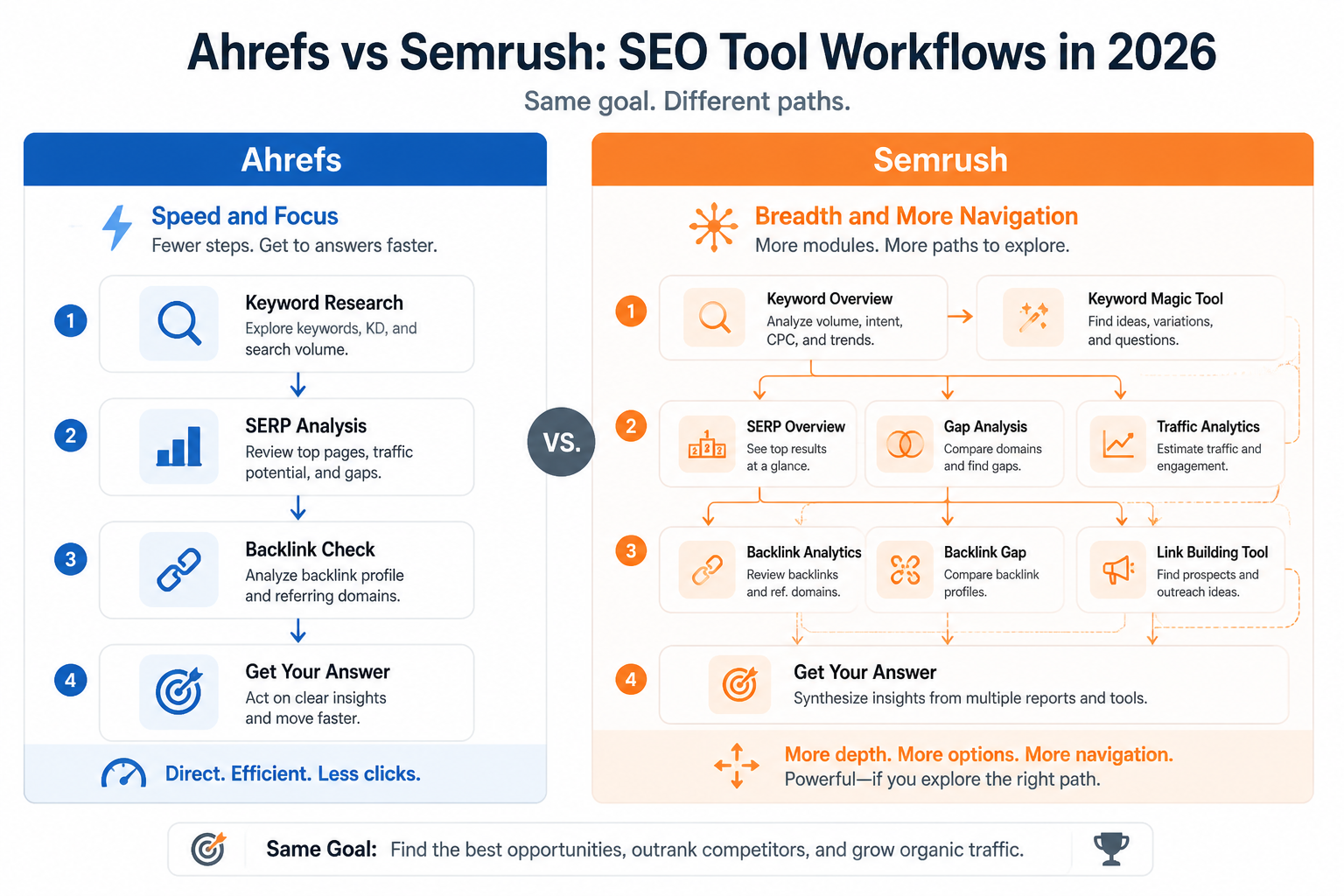
This was one of the clearest patterns in my testing. Ahrefs still feels better when I want to sit down, type in a seed topic, and quickly carve out a content plan. I like the flow. The related keyword paths make sense. The filtering feels snappy. I can move from broad topic to realistic target without much friction.
Semrush is very capable here too, and in some cases it gives me a wider view of intent, SERP patterns, and surrounding terms. But I often feel like I have to do a little more interface management. Not hard. Just more clicking, more sorting, more deciding which report I should trust most for the task in front of me.
If I were building a fresh content site and spending most of my time on topic selection, I’d personally lean Ahrefs. It helps me keep momentum. I get from idea to article cluster faster, and that counts for a lot when you’re trying to publish consistently.
Semrush does win points if your process includes a lot of adjacent research. If you want keyword ideas plus broader market context plus PPC signals plus more competitive overlays in one place, it can be a better home base.
Competitor Research: Semrush Gives You More Angles
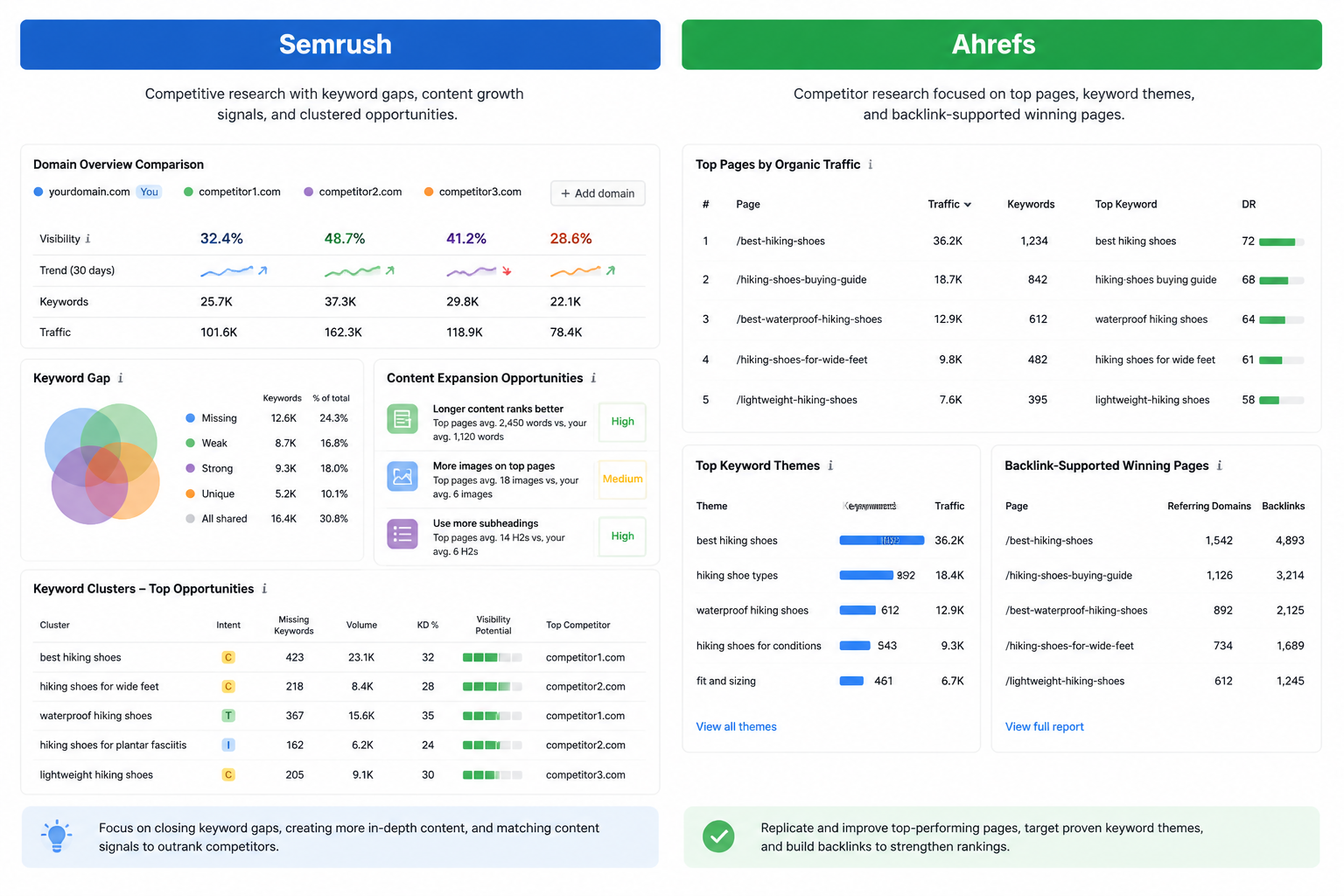
This is one area where Semrush keeps earning its reputation. When I’m picking apart a competitor, especially in a crowded niche, Semrush often gives me more ways to inspect what’s happening. Organic keywords, traffic trends, keyword gaps, position changes, domain comparisons, top pages, paid overlap. There’s a lot there.
That can be great or annoying depending on your temperament. On one project, I loved it because I was trying to understand why a competitor suddenly jumped in visibility. Semrush gave me enough context to spot a pattern in content expansion and ranking movement. On another project, I just wanted five decent content opportunities and felt like I was standing in a warehouse.
Ahrefs handles competitor research well, but it tends to feel more direct. I can often spot top pages, keyword themes, and backlink-supported winners faster. If I’m doing focused content-first competitor research, that simplicity works in its favor.
If your job involves a lot of reporting across multiple domains or explaining competitor movement to clients or stakeholders, Semrush probably gives you more to work with. If your job is mostly “find the opening and publish the page,” Ahrefs feels lighter on its feet.
Backlink Data: Still a Real Strength for Ahrefs
Every time I do one of these comparisons, I expect the backlink gap to shrink enough that I stop caring. Every time, I still end up preferring Ahrefs for link analysis.
It’s not that Semrush is bad here. It’s solid. You can absolutely do backlink research, find opportunities, and compare domains. But Ahrefs still feels more natural for link-first work. I trust the workflow more. The reports are easier for me to scan. When I’m checking whether a page ranking above me is being held up by links, Ahrefs is often where I want to look first.
I ran this on a few sites where rankings were stubborn and the answer ended up being pretty obvious after checking links. Ahrefs made that diagnosis fast. Semrush got me there too, but with more report-hopping.
If link building is central to your strategy, Ahrefs still has a real edge in how usable that part of the product feels.
Site Audits and Technical Work: Semrush Feels More Built Out
This is where Semrush starts pulling ahead again for me. If I’m working on technical cleanup, tracking issue buckets, and keeping an eye on broader site health, Semrush feels more complete. The auditing system is organized in a way that works well for recurring maintenance. It’s especially useful if more than one person touches the site and you need a shared place to review problems.
Ahrefs has site auditing too, and it’s useful, but I don’t find myself wanting to live there in the same way. For solo builders who just need a passable audit layer, it may be enough. For agencies or teams with more formal workflows, Semrush is easier to justify.
One small lesson from testing: audits are only as good as the person interpreting them. Both tools can throw a huge list of issues at you. I made the mistake on one project of chasing low-impact fixes because the report made them look urgent. The pages that actually needed help were thin and misaligned with intent. No crawler was going to solve that for me. So yes, Semrush wins here, but neither tool replaces judgment.
Rank Tracking and Reporting: Semrush Makes More Sense for Teams
If I’m just tracking my own pages, both tools can do the job. If I’m tracking multiple projects and need cleaner stakeholder-friendly reporting, Semrush starts to feel more comfortable.
This gets into the broader personality difference between the two products. Ahrefs often feels like a researcher’s tool. Semrush often feels like an operations tool. That’s a simplification, but it holds up surprisingly well once you’re inside actual workflows.
When I imagine an in-house marketing team meeting every week, Semrush fits that room better. When I imagine a solo builder with ten tabs open, trying to decide what to publish next, Ahrefs feels more at home.
Interface and Everyday Use: This Matters More Than Feature Lists
This part gets underrated in reviews because it sounds subjective. It is subjective. It also matters a lot.
I found Ahrefs easier to enjoy using. That sounds soft, but it affects output. If I don’t dread opening the tool, I do more research, follow more rabbit trails, and catch more opportunities. Ahrefs generally gives me that feeling. Cleaner flow. Less clutter. Fewer moments where I’m asking, “wait, which report was the useful one again?”
Semrush has improved, and I don’t want to pretend it’s a mess. It isn’t. But the product still carries the weight of trying to do many things for many users. Sometimes that means the path to the answer is longer than I want it to be.
If you love having every angle available, that won’t bother you. If you value speed and focus, it might.
Pricing Pressure Changes the Decision
By 2026, the bigger question is not just which tool is better. It’s whether the amount you pay maps to the amount of action you take from it.
I’ve made this mistake before. I subscribed to a powerful SEO tool, spent a week feeling like a genius, exported a pile of data, and then barely used half the features I was paying for. That’s not a software problem. That’s a workflow mismatch.
If you’re a solo creator, niche site builder, or lean startup team, Ahrefs often feels easier to justify if your main jobs are content research, SERP analysis, and backlinks. You may get more direct value because the core workflows are the ones you actually use every week.
If you run an agency, manage multiple clients, or need a broader reporting and planning layer, Semrush can make more financial sense even if you personally like Ahrefs more. You’re paying for range and structure as much as the raw SEO data.
Where Semrush Wins in 2026
- Better fit for agencies and multi-person teams
- Stronger technical audit and project management feel
- More angles for competitor research
- More useful if your work crosses into broader digital marketing tasks
- Reporting and organization feel more ready for stakeholder use
Where Ahrefs Wins in 2026
- Faster keyword research workflow for content-focused builders
- Stronger backlink research experience
- Cleaner, more intuitive interface for everyday SEO work
- Better fit for solo operators who want speed over system complexity
- Easier to stay in a productive groove without bouncing between too many modules
The Mistake I’d Avoid If I Were Choosing Again
I would not choose based on the longest feature list. I did that before, and it was the wrong frame. The better choice is the one that matches the bottleneck in your current process.
If your bottleneck is finding winning topics and understanding why competitors rank, Ahrefs probably helps more. If your bottleneck is managing SEO as an ongoing system across clients, pages, audits, and reports